

I. When the Veil is Lifted by Her Own Arms
May 4, 2026, Upper East Side, New York. Lisa Manobal walked the Met Gala red carpet for the second time, but this time her role changed—no longer just a guest, but a member of the organizing committee.
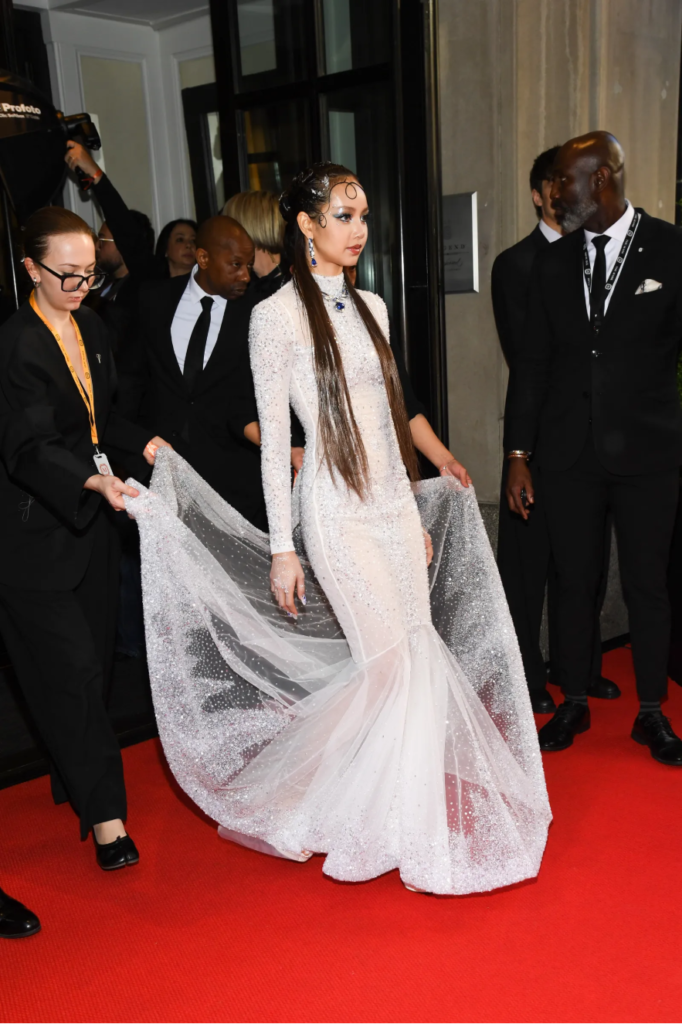
She wore a gown that made everyone stop in their tracks: a semi-transparent ivory bodycon dress adorned with 66,960 Swarovski crystals, resembling a frozen galaxy under the flashing lights. But what truly elevated the dress from “beautiful” to “unforgettable” were the “extra arms” extending from behind her shoulders—not real limbs, but sculpted installations cast from 3D scans of her own arms, gently lifting the veil connected to her dress with gestures reminiscent of traditional Thai dance.
This visual effect was almost surreal: it was as if she possessed two bodies simultaneously, one breathing, the other performing. And both were her.
II. Five Years of Remote Collaboration, One Day Face to Face
Lisa’s connection with Robert Wun dates back five years.
During those five years, she frequently wore the Hong Kong designer’s creations to various events—from magazine shoots to stage costumes; Wun’s dramatic designs almost became part of her personal style. Ironically, however, the two didn’t actually meet for the first time until the preparations for the 2026 Met Gala.
“For someone like me, a former fashion student, this is a moment you look up to,” Wun later described the Met Gala’s significance to him. Lisa clearly also saw this collaboration as a milestone—not because she finally met her long-time “online friend,” but because this meeting led to a piece truly belonging to her.
III. The Body Code of Thai Dance
Wun’s designs are never mere decorations. The core inspiration for the gown he created for Lisa came from two directions: this year’s Met Gala theme, “Costume Art,” and Lisa’s own body.
The design team conducted 3D scans of Lisa’s arms and then transformed the scan data into a sculptural installation. These “extra arms” weren’t randomly placed; they borrowed classic gestures from traditional Thai dance—the slightly bent fingertips and elegant wrist rotations—a bodily memory Lisa had been familiar with since childhood.
This approach elevates the dress beyond mere aesthetics. It becomes a cultural translation: transforming the ritualistic postures of Thai dance into a wearable sculpture on the steps of the Metropolitan Museum of Art through 3D printing and haute couture. Lisa’s body is both canvas and content.
IV. From Party Girl to Committee Member
A year ago, Lisa’s Met Gala debut exuded a completely different aura.
In 2025, fresh from filming the second season of Hotelier and her solo performance at Coachella, she appeared in a Louis Vuitton tweed jumpsuit, blazer, and logo-printed sheer stockings. That look was a declaration: I’m a pop star, I’m here, and I want everyone to see me.
Subtle layers lie hidden in the details: embroidered on the inside of her suit jacket is a portrait of artist Henry Taylor—the painter who once illustrated the cover of Vogue for Pharrell Williams. This “wearing art” approach already foreshadows her natural affinity for the theme “Fashion Is Art.”
But in 2026, she chose a quieter, more ritualistic expression. From party girl to committee member, from logo stockings to 66,960 crystals, Lisa used two Met Galas to complete a narrative arc about growth.
V. The Hidden Meanings of Jewelry and Nails
For accessories, Lisa chose high jewelry from Bvlgari.
A high jewelry sapphire necklace from the Eclettica collection, paired with earrings set with two pear-shaped sapphires. Even more striking was the pair of 3D-printed “extra arms,” adorned with Bvlgari’s Serpenti necklace, bracelet, ring, and watch—as if these sculpted limbs were not merely decorations, but independent wearers.
Her manicure was equally meticulously designed. Celebrity manicurist Juan Alvear revealed that the nails were inspired by the “frozen” texture of Bvlgari jewelry, a response to Wun’s signature play of elements. The icy blue kiss manicure created a cool-warm contrast with the ivory dress, like the final piece of a complete puzzle.
VI. Wun’s Met Gala Night
Lisa wasn’t the only guest to wear Robert Wun that night. In fact, the Hong Kong designer set a remarkable record at the 2026 Met Gala—styling eight guests, far more than any other brand that night.
Besides Lisa, other notable figures include tennis star Naomi Osaka (whose detachable ivory coat concealed a red crystal gown embroidered with over 659,000 stitches, taking 3,280 hours to create), Thai editor Nichapat Suphap (whose kinetic hand installation inspired by Michelangelo’s The Creation of Adam), and artists such as Audrey Nuna and Jordan Roth.
More importantly, Metropolitan Museum of Art curator Andrew Bolton included three of Wun’s works in the permanent collection of the “Costume Art” exhibition. For a young designer who only officially transitioned to haute couture in 2020, this represents an almost overnight leap from “emerging” to “being written into history.”
VII. The Metaphor of Four Hands
Returning to Lisa’s gown. What do those extra arms truly signify?
From its most direct perspective, it’s a visual expression of the “Fashion Is Art” theme—the body is extended, replicated, and rearranged; clothing is no longer just a second skin covering the body, but rather a conspire with the body to create a new form of existence.
But on a deeper level, it might also be a metaphor for Lisa’s own situation. As a member of BLACKPINK, she possesses the invisible arms of “group identity”; as a solo artist, actress, and brand ambassador, she continues to grow new limbs. The girl with four arms is both the object of observation and the one who holds up her own destiny.
She smiles on the red carpet, the crystals sparkling under the lights, her extra arms maintaining the graceful posture of Thai dance. At that moment, she truly resembles a work of art—not the static kind in a museum, but the kind that breathes, moves, and tells its own story.