

When the playfulness of short skirts and the formality of long skirts seem a bit too much, midi skirts quietly occupy the middle ground between the streets and the runways.
They’re not overly flamboyant, yet they always manage to draw attention to the curve of the hem and the rhythm of your steps with every turn.
This article will focus on three practical and versatile midi skirt styles, breaking down their characteristics, suitable groups, and styling formulas, so you don’t have to chase trends to create your own unique look with a midi skirt.
I. Midi A-line Skirt: The Airiness of Walking
The most captivating aspect of the midi A-line skirt is its seemingly casual yet carefully calculated “airiness.”
The hemline gently flares out below the knee and above the ankle, swaying naturally with every step. It’s not demanding on leg lines, yet surprisingly slimming.
- The Key to Fit and Length
A skirt length that falls at the slimmest part of the calf is more flattering than one that falls just below the knee.
A waistline slightly higher than the natural waistline creates a more upright silhouette and is more flattering for the body proportions of East Asians.
The A-line skirt shouldn’t be overly voluminous; ideally, it should “sway gently when walking,” resulting in a more streamlined look for everyday wear.
- Suitable People and Occasions
For commuters who are self-conscious about their leg shape but don’t want to always hide behind wide-leg pants.
For days when you need to wear this from the office to a date after get off work: it’s both elegant and not too stiff.
During the transitional seasons of spring and autumn, when the wind is slightly cool, an A-line skirt is more comfortable than a short skirt.
- Practical Styling Formulas
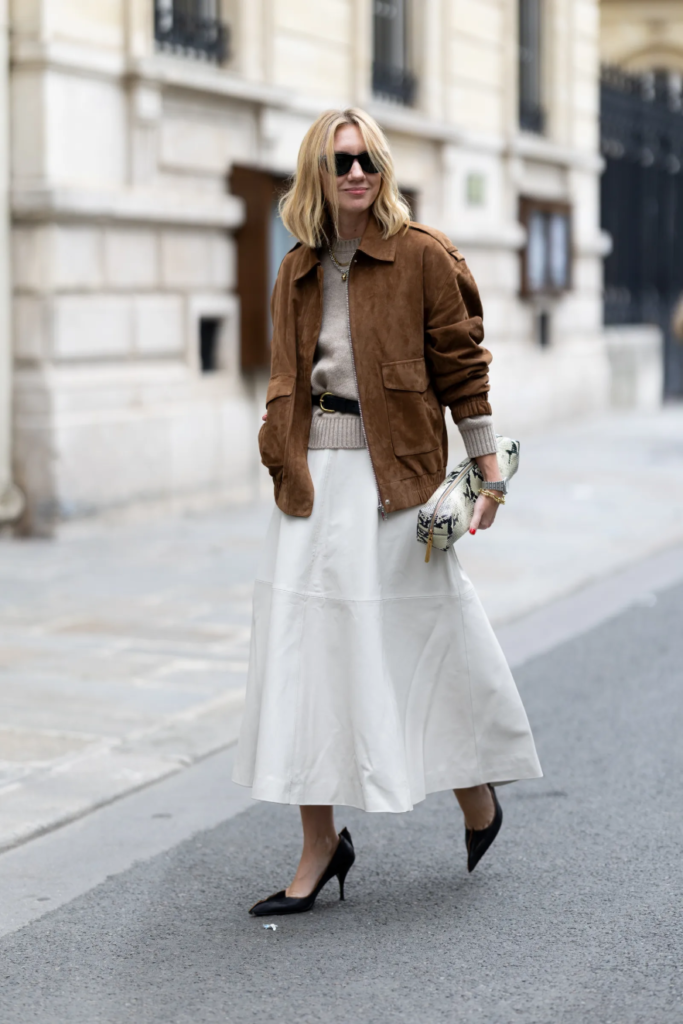
A-line skirt + fitted knit top: The narrow top and wide bottom accentuate the waistline, making it a foolproof formula.
A-line skirt + shirt (tucked into the waistband): The contrast between “soft” and “structured” creates a more sophisticated look.
Suggested footwear: Pointed-toe flats, loafers, or low-heeled ankle boots to avoid a bulky silhouette.
Take a few steps in the gentle breeze, and the hem of your skirt sways slightly. That effortless elegance is more pleasing to the eye than any elaborate design.
II. Straight Midi Skirt: A Calm and Composed Line
If an A-line skirt is a flowing, airy curve, then a straight midi skirt is a quiet yet resolute straight line.
It doesn’t flaunt its shape, but subtly outlines the body’s silhouette, projecting an aura of “natural professionalism” into everyday wear.
- Key Design Considerations
Straight doesn’t mean tight-fitting. Ideally, it should fit slightly around the hips, leaving one or two fingers’ width of room at the thigh.
The slit should be placed at the back or side, and the length should be around the knee, a compromise between movement and elegance.
Choose a fabric with slightly stiffness, such as cotton, blends, or a slightly stretchy suiting material to maintain a clean silhouette.
- Who Should Wear a Straight Midi Skirt?
Those who frequently attend formal occasions but don’t want to rely solely on suit trousers.
For those who prefer minimalist style and express their style through clean lines rather than patterns.
For those with a fuller lower body who don’t want to feel constricted, a straight skirt is much more forgiving than a tight pencil skirt, provided it’s well-tailored.
- Outfit Inspiration and Formulas
Straight Skirt + White T-shirt: A minimalist approach using basic items, perfect for a “low-energy” weekend look.
Straight Skirt + Blazer: No need for a complete blazer; simply coordinate the materials of the skirt and blazer.
Straight Skirt + Sneakers: Breaks the formality of skirts, especially suitable for city commutes or everyday travel.
The charm of a straight midi skirt lies in its ability to not steal the spotlight while maintaining a sophisticated and appropriate look in any situation.
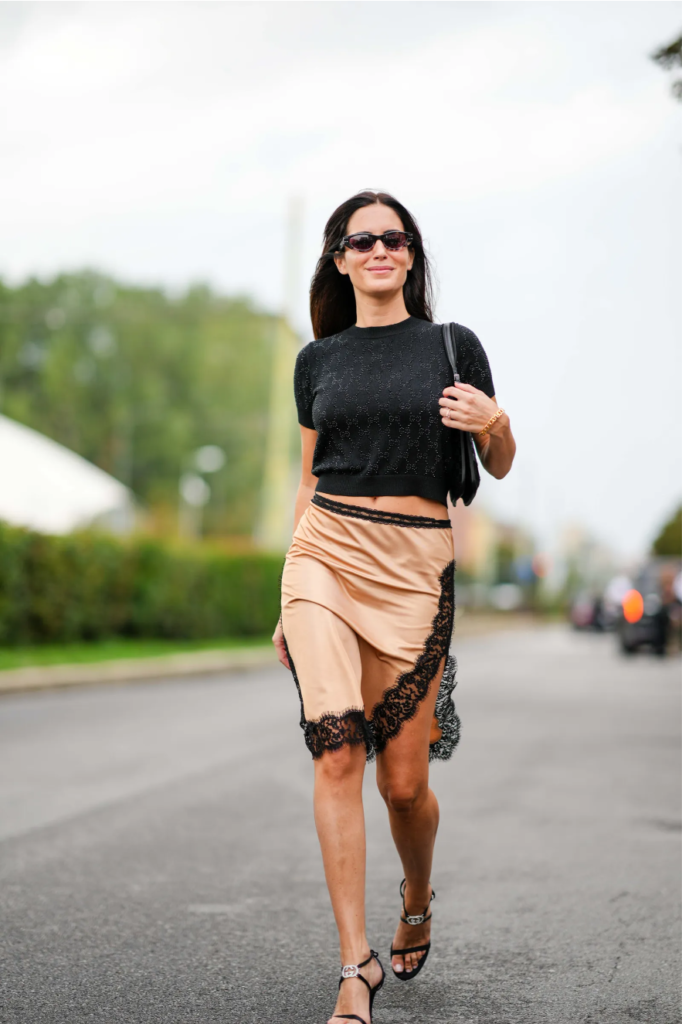
III. Flowing Chiffon Midi Skirt: Light yet not overly sweet
When the sunlight softens, many people instinctively pull out their chiffon skirts from their wardrobes.
While lightness is undeniably captivating, the key to making a truly durable chiffon midi skirt lies in striking a balance between ethereal elegance and mature sophistication.
- The Balance of Fabric and Pattern:
Choose slightly heavier chiffon or double-layered designs, avoiding overly sheer or wrinkle-prone materials.
Patterns can include small floral prints or low-contrast geometric patterns, offering depth without being overly sweet.
Solid-color chiffon midi skirts are more forgiving in terms of styling than large-scale prints and are a better starting point.
- Breaking the Sweet Stereotype:
- Chiffon skirt + neutral pieces: such as a well-tailored shirt, workwear jacket, or denim jacket, using a strong silhouette to balance the softness of the skirt.
- Chiffon skirt + simple accessories: delicate chain necklaces, small hoop earrings, or solid-colored belts, keeping the focus on the flowing movement of the skirt.
- In terms of color, try misty blue, smoky purple, and light khaki, which will appear more mature than pink tones.
- Suitable Occasions
Weekend dates, city walks, exhibitions, or cafes – a chiffon midi skirt can be worn from day to night.
On a vacation, simply change into sandals or a woven bag to effortlessly transition from city to beach.
In a less formal office setting, layering a cardigan over it maintains a polished look.
Flowiness doesn’t equate to weakness; on the contrary, just the right amount of lightness allows for a touch of gentleness even in a busy schedule.
IV. Midi Skirts and Body Proportions: Balance is More Important Than “Slimming”
When it comes to wearing skirts, people often start by asking, “Does it make me look slimmer?”
However, the real advantage of midi skirts isn’t just about concealing; it’s about creating a more harmonious overall proportion through adjustments in length and lines.
- How Petite Women Can Wear Midi Skirts
Choose a high-waisted design, with the waistline positioned one finger’s width higher than usual. This will naturally lengthen the leg line. - Skirt Selection: Avoid overly wide skirts; A-line or slightly flared skirts are preferable, drawing attention to the waistline rather than the hem.
- Shoes: Choose nude shoes close to your skin tone, low-heeled mules, or sandals with a slight heel to reduce the feeling of a “cut-off” in silhouette.
- For Fuller Lower Bodies: Avoid overly thin or clingy fabrics. Materials with moderate thickness and drape are more flattering.
Dark colors are generally safe, but try low-saturation greens, blues, and browns. They are visually slimming but offer more personality.
A moderate slit is more flexible than a completely closed skirt and reduces the visual burden of a “heavy lower body.”
- For Unbalanced Upper and Lower Body Proportions: Use a midi skirt as a focal point and employ short jackets, cinched hems, and small bags to draw attention to the waistline.
For the upper body, choose structured pieces, such as jackets with defined shoulders, to create a more upright and elongated silhouette.
Avoid pairing an overly baggy top with a full skirt, as this can overwhelm you with fabric.
Instead of chasing the single standard of “slimming,” use a midi skirt as a tool to adjust proportions, allowing your figure to appear its most natural state as you move.

V. Starting with your wardrobe: How to choose your “most frequently worn” midi skirt The clothes truly worth keeping are never the most stunning ones, but rather the ones you most often reach for without hesitation.
To find that frequently worn midi skirt among a dazzling array of styles, consider the following:
- Color: Find the answer in your current wardrobe. Open your closet and observe the colors of your most frequently worn tops. Choose a skirt color that naturally complements them.
If your wardrobe is predominantly dark, a neutral-colored (beige, gray, khaki) midi skirt will be more versatile.
If you’re used to a minimalist color scheme, try letting your midi skirt add a touch of color, such as a low-saturation blue or green.
- Touch and Weight: Take a few steps to feel if the hem gets stuck on your legs or is easily stepped on.
Overly thin fabrics can be difficult to care for in real life; a moderate weight is more suitable for everyday wear.
A soft yet structured feel is ideal for repeated wear and frequent washing.
- Suitability for Everyday Life: Imagine how many ways you can style it in a week: with a T-shirt, a shirt, a knit, sneakers…
A skirt that can be worn from weekdays to weekends, from the city to a short trip, truly deserves the title of “wardrobe darling.”
If you’re already eager to create tomorrow’s outfit with it in the fitting room, then it’s usually the right choice.
VI. Leave Some Room for Everyday Wear: Fashion changes, and skirt lengths fluctuate.
The reason midi skirts repeatedly return season after season isn’t just because they’re beautiful, but because they offer just the right amount of flexibility: flexibility in terms of body shape, movement, and mood.
If you’re willing, why not start tomorrow by letting a midi skirt step out of your wardrobe and into real-life situations? Perhaps you’ll discover that that seemingly ordinary skirt is subtly changing the way you interact with the world.